
Credits
Concept and production by VOLNA
© VOLNA (2020)
| Dimensions | 5000 × 5000 × 1000 mm |
|---|---|
| Artist | VOLNA |
| Type | Original Artwork |
| Material | Steel frame, triplex glass, 3D-printed components, custom Art-Net controller, custom mechanical modules |
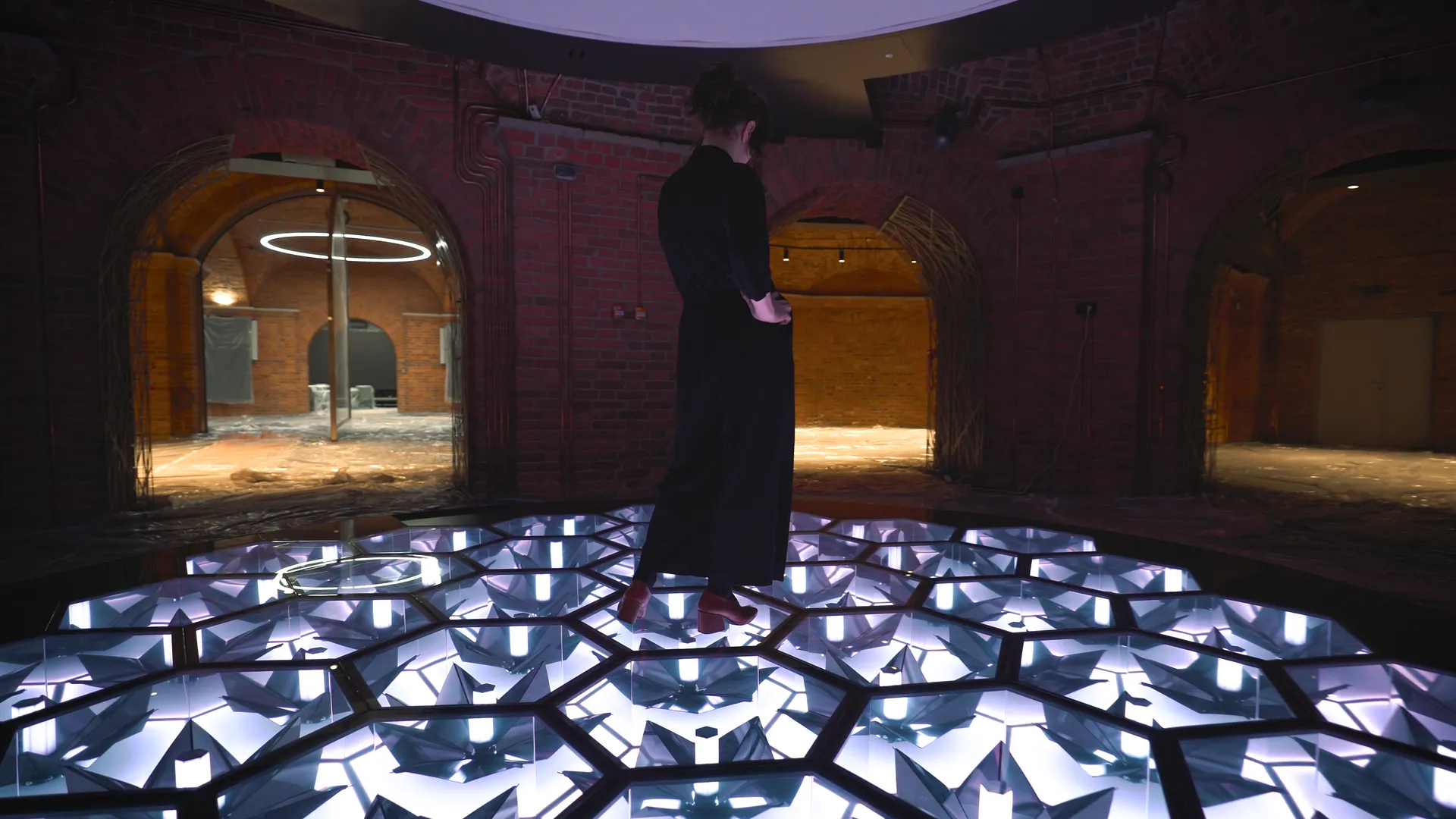
| Description | The kinetic light installation Nymphéas is an art-within-architecture project set up on permanent display in one of St. Petersburg’s exhibition spaces. It is inspired by the lyrical images of ponds overgrown with water lilies next to which poets and artists—such as Claude Monet in his garden in Giverny—have spent countless hours in contemplation of the clean, cold flowers. Visitors can walk freely across the surface of the pond while watching the gentle movements of the mechanical water-lilies as they shimmer with different colors in an optically expansive space below. The reflections of the flowers and the people observing them are compounded, creating a sense of submersion into the depths of a surreal pond. The installation consists of 37 kinetic light modules mounted on a steel frame and covered with triplex glass. Each module consists of a “flower” that operates based on custom-designed mechanisms. For this installation, a unique set of 3D-printed details and a custom Art-Net controller were created, allowing the installation to be controlled externally with a standard lighting console or third-party software. The visual and conceptual idea of the installation is enhanced using specially developed light and movement scenarios, combinations of which allow for over 100 different original variations. The whole circular “pond” is 4.85 m in diameter and 0.6 m in height (elevated 0.15 m from the ground). Work on the installation took three months during the beginning of 2020 and included the production of a modular steel frame, mechanisms and decorative elements, all of which were finally assembled on site during interior construction. Although Nymphéas has already been installed in a permanent exhibition space, it has not yet been presented to the public due to the coronavirus pandemic. |